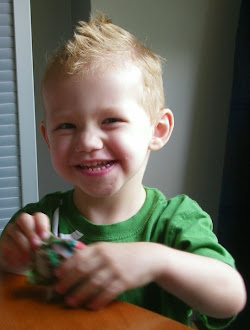
i don't remember mentioning this here, but maybe i did... asher had an appointment in toronto yesterday. echo, ecg, cardiology, and pacemaker clinic. it promised to be a busy and interesting morning.
first up, i met quickly with someone from the CHSS (Congenital Heart Surgeons' Society) for our yearly check-in for the LVOTO (Left Ventricular Outflow Tract Obstruction) study that asher is part of. basically, the CHSS are following kids who, like asher, have issues with blood leaving the left ventricle. quoth i on FB the other day,
i'm amused by the LVOTO study asher is in. hmm... i guess a non-existent left ventricle and absent "outflow tract" would count as an obstruction, right? ROFL (oh, the things i laugh at anymore... LOL)the study is nothing intrusive. every year i have to fill out a questionnaire and list everything asher's been through in the last year. the CHSS is doing a long-term study, looking at outcomes for kids like asher and others with HLHS and LVOTO defects. (for the record, i enroll asher in every study i'm approached about. selfishly, it's that many more people keeping an eye on my littlest man. but my main reason is this: i believe that we have a responsibility to use everything we have been given - the good and the "bad" - to help others. asher has been given half a heart. and so, when we're appraoched, i enroll him. i pray that the docs and surgeons will find ways to help kids with HLHS and other complex heart defects, so that others will not have to go through what asher has been through. but that's a tale for another day...)
so i met with carol, filled out the form (and noticed how many admissions over the last couple years have been for sepsis... shudder! it's one thing to know, it's a whole other thing to see it written down like that...) and then we went in for the echo.
my mother had come with us. and she was fascinated by the echo, having never seen one before. asher did very well, staying still and quiet for most of it. (and this is why there's a TV in every paeds echo lab. because it's too hard to keep a 4-year-old boy quiet for 45 minutes at a stretch. haha) i watched the echo, too... his heart is so beautiful, so simple, so complex, so scarred, so new... a work of art, truly.
(yes, i do love cardiology. why do you ask?)
then off to the ECG lab. asher put on the leads, with some help from the tech. i looked at the monitor. heart rate: 109 bpm. (remember that number. it's important.) so we got asher to sit still for 10 seconds, the tech printed off the report, and then she asked, still looking at the ECG, "does he have a pacemaker, mom?"
now, some of you might be thinking, "well, duh!!! of course he does!!"... but you should realize, there was no mention of the pacer on the orders. it said, "HLHS." that's it. no mention of the electrophysiological disaster area that is asher's heart. nope. just "HLHS." so she should have had no way of knowing that he had a pacemaker, just by looking at the tracings on her screen.
as i answered, "oh! yeah, he does."... i peaked over her shoulder at the monitor... and saw... a tell-tale spike before the squiggly wave. that spike... is the pacemaker, shocking asher's heart to induce a beat.
remember, asher's heartrate during the ecg was 109.
asher's pacemaker is set at 80.
which means that it should fire when he's beating below 80 bpm, and is supposed to stop pacing when he's over 80.
109 is over 80.
did you catch that??? remember how i've been saying for a while now that there's a problem with his pacemaker? yup. read on, gentle reader, read on.
so we saw dr r, who said that everything looked fine. asher's heart is working well, the muscle is strong and function is good. there is no obvious cause for the fluid retention the other week, but she said that sometimes fontans just need a couple days of diuretics, so it's nothing to be too concerned about. basically, "heart's fine. look elsewhere." no worries, there. kind of a relief.
but i was most looking forward to pacemaker clinic.
and it proved to be interesting, indeed.
we got in to that clinic at 1:00. i spoke with the nurse/tech, outlining my concerns.
- his heart rate went down to 74 and stayed there for quite a while, and he had pain in his chest radiating down his left arm and into his jaw.
- his heart rate, whenever checked, is 100. exactly. every. single. time.
- the pacer spike on the morning's ECG.
she said, "yes, that does seem suspicious, doesn't it?"
she listened!!!!!
so she hooked him up to a monitor, which started showing his current (no pun intended) ECG tracing. "see what i mean?" i exclaimed, "his pulse is 95 and the pacer's firing!"
she looked and was surprised, first, that it would be doing that, and second, that i knew what i was looking at. (she then told me about a new Physician Assistant programme in canada, and she strongly urged me to look into it and specialize in paeds cardio. she even gave me her card so i can let her know if i decide to pursue it, because she's really interested in it, too. but back to asher. haha) she watched the monitor for a moment, waiting to see if it was just a fluke, a momentary firing, or something significant.
it was something significant.
she continued with her pacemaker exam, checking its settings and collecting its data. she showed me that his heart rate is, correctly, just above 80 most of the time, and that his heart rate is elevated appropriately for his age (it looks like it goes up with activity, which is what a heart rate is supposed to do). and she kept looking...
and remembering what i'd said about his heart rate always being 100 whenever it's checked...
she did a little test.
she unhooked asher from the monitor and took him into the hall. there, she, asher and my mother ran up and down the hall (well, the women ran; asher walked quickly and yelled at them. he was tired and grumpy and wanted to leave). then they came back into the room, and she hooked him back up to the monitor...
and his heart rate was 155, which was
- appropriate for an active heart rate in a child his age.
- nearly double the pacemaker's setting.
- paced.
that's right, you read that correctly.
his heart was beating 155 times per minute, and the pacemaker was prompting the beats.
she went and got the EP fellow.
he looked at the data, and agreed that asher's pacemaker wasn't working the way it's supposed to. "it's too sensitive," he said. so christine fiddled with the settings and made asher's pacemaker work properly.
then she threw in a little bonus: a sleep mode. during the day, asher's pacemaker will keep his heart rate above 80. overnight, from 9:30 to 7:15, it will keep him above 70. when he's sleeping, he doesn't need as many beats, so he can safely go down to 70. this will save the battery, but also allow for better sleep, among other things.
see, if his pacemaker was keeping his HR artificially high, that could account for a lot of the symptoms asher has been having, including,
- paleness and grey spells
- looking flushed
- irritability
- chest pain
- shortness of breath
- reflux
- difficulty sleeping
- loss of appetite
do those symptoms sound familiar? they are CHF symptoms, but they are also what asher has been experiencing over the last few weeks.
do you realize what all this means?!?!
i texted to some friends,
hey! guess what! the pacer was "too sensitive"!!! so she fixed it! which means... there WAS a problem, it DOESN'T need to be replaced, and i'm NOT insane!!!honestly, i could have cried. it was such a relief to know that i wasn't imagining things, and that, while it sucks that asher's pacemaker wasn't working properly, it was easily fixed. all it took was for someone to listen to me and take me seriously. rather refreshing, i'll be honest.
now, i just want to make this clear: i really like our cardio in london. she is lovely and caring and talks to me as one mother to another. all rare qualities in a doc, and welcome traits, at that. but all this could have been fixed over a month ago, when i first raised the issue. all it would have taken was for her to take asher for a quick run around the clinic for a couple minutes, and maybe a monitor in the room to hook him up to during the tests. honestly, i'm not sure where this leaves us. i can't afford to leave the london clinic and deal solely with toronto; i just can't. yesterday alone cost me the equivalent of one week's groceries. one day. one week's grocery bill. not do-able in the long run. on the other hand...
toronto listens. toronto looks deeper. toronto fixes things.
oh! and in case you're wondering if, indeed, the pacer was the cause of asher's issues lately...
while i'm not a doctor and have no real medical training, i can tell you that his colour is returning (he was already looking better before we left the hospital yesterday), and he's less irritable and eating more. already. he is refluxing less and as i type this post, he is sleeping comfortably upstairs.
just sayin'.
all in all, it was a good day. a long day, but a productive one. i'm "happy" and asher's feeling better.
so, i want to thank everyone who has been praying for asher and this appointment. your prayers were (and are) very much appreciated. and see? prayer works!